

Young people's experiences of periods and period pain
Advice for young people
We asked the young people we spoke to what advice they would give other young people about periods and period pain. Their main messages were to:
- Talk to others about your experiences and challenges
- See a healthcare professional if you have any concerns
Poppy doesn’t want anyone to think it’s normal to have to deal with a lot of pain. She would encourage anyone with period pain to “go and get help”.
Poppy doesn’t want anyone to think it’s normal to have to deal with a lot of pain. She would encourage anyone with period pain to “go and get help”.

I just think that, you know, getting help is really important if you’re in a lot of pain, and I don’t want anyone to feel like, you know, that it’s... that they should just deal with it and that it’s just normal, because if you’re in a lot of pain, then it’s not normal. And obviously every period looks different for everyone, and it can fluctuate, and it can be heavier some months and lighter the next, but yeah, I just definitely, you know, would encourage people to... to go and get help if they’re in a lot of pain.
Talk to others about your experiences and challenges
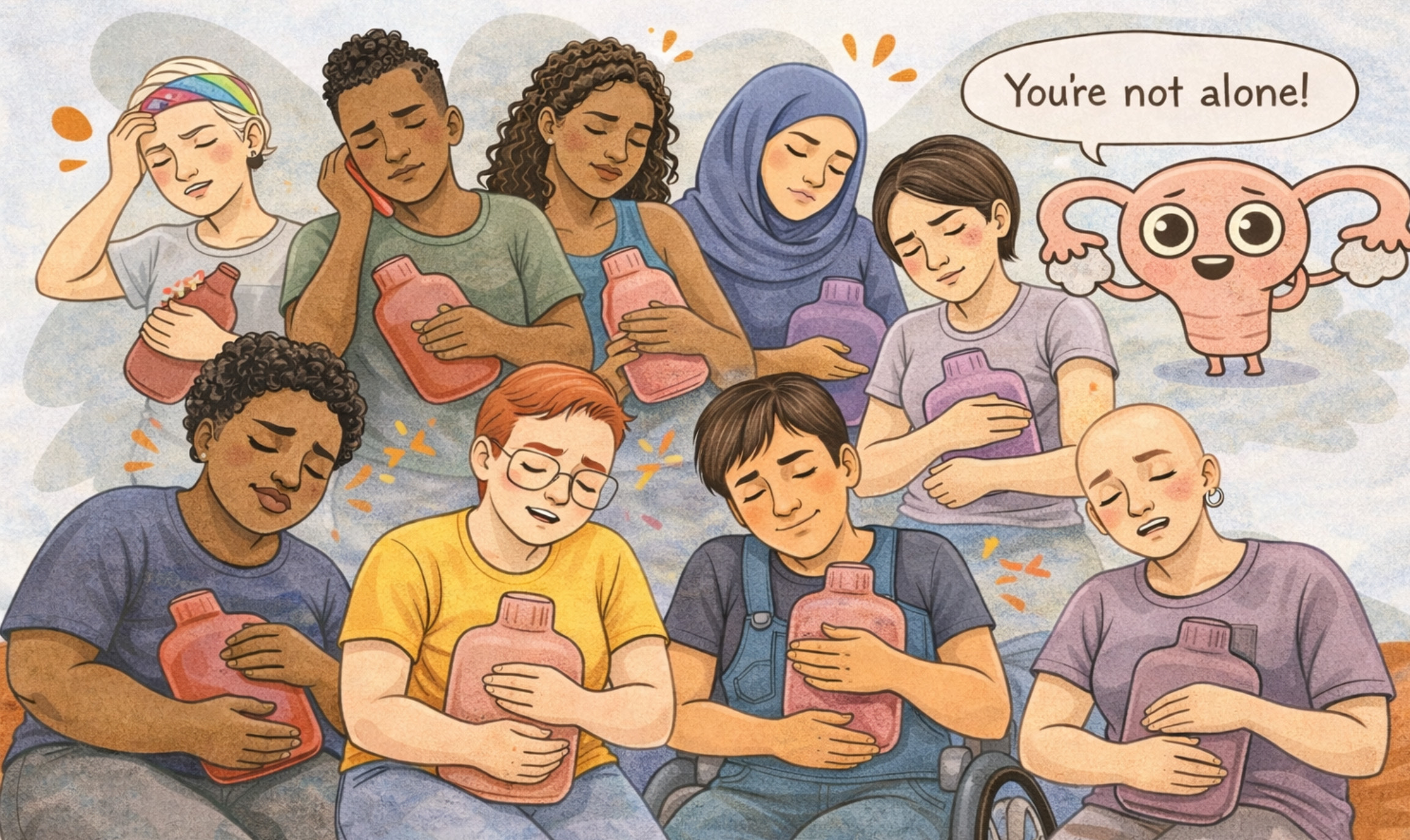
(Artwork by Arina Grosu from our Patient and Public Involvement and Engagement panel)
A number of young people encouraged others to talk about periods and period pain. For some, like Yvette and Jade, this advice came from having found talking about periods and period pain difficult, especially when their periods were first starting and not everyone around them had started theirs. They found talking with friends and others with experience of periods a helpful way of finding support and information. As Jade said of talking to her friends about periods, “they make it so much easier”.
Talking about periods could bring connections with others having similar experiences. Reham encouraged young people to “try to talk more about it, and don’t be embarrassed, ’cause everyone’s... like nearly every woman in the world’s going to have... going to be going through the same thing as you, so just be able to talk, and try to feel comfortable talking about it”.
Yvette wishes she had always been comfortable talking about periods because she has learned that, when people share experiences, everyone gains knowledge.
Yvette wishes she had always been comfortable talking about periods because she has learned that, when people share experiences, everyone gains knowledge.
I should have been comfortable talking about it with anyone. I think everyone has a- has different experiences. They would share. Then you know what you are going into and what you have to know. I think they will teach you so many stuff if you ask, because lots of education is not based for knowledge, is not from one person. It's basically from everyone. Someone can know something that the other doesn't know, so if you ask and you’re comfortable asking, I think you would get lots of knowledge from it, yeah.
A number of young people encouraged talking about periods and period pain as a way of making it easier for everyone, but also recognised that this could be tricky and go against social expectations. Rosie explained that, “even though it is sort of still not talked about, that doesn’t mean that you can’t talk about it”. In Jian’s experience, “a lot more people will be understanding about it than you think”.
Ela also thought that starting conversations about periods could be worthwhile: “even if you don’t talk about it with your friends yet, I’m sure if you were to start a conversation with your friend who also has it, they would be like: “Oh, my God, I’m so glad you feel the same,” ’cause there’s this sense of relief when you talk about it with someone, even if it’s your mum, or if you have an older sibling, I think that really helps …don’t be afraid to talk about it”.
Talking to others was a way that young people could get information about periods and managing period pain. Chloe reminded others that “you’re not like expected to know everything”. Sharing ideas was welcomed and Reham, who found drinking milk with honey soothing, advised young people to “try and find something that works for you”.
See a healthcare professional if you have any concerns
A key piece of advice young people wanted to share with others was to go see a doctor if what they were trying for period pain was not helping or not helping enough. Ivy encouraged young people in this situation to “reach out for help”. As Hannah X put it, “just because everybody gets period pain …doesn’t mean that you shouldn’t be asking for help for it if it’s stopping you from doing things”. Amalia, who had found hormonal contraception really helpful for her period pain, said that if she could give her younger self advice, she would tell her to go earlier to get medicine.
Iris advises young people with cramps that are stopping them doing what they want to see a doctor, because she says medication has “literally transformed my life” (read by an actor).
Iris advises young people with cramps that are stopping them doing what they want to see a doctor, because she says medication has “literally transformed my life” (read by an actor).
So, would you have any advice for other kinda young people?
I think young people starting... starting their periods, I think if you get the odd occasional cramp or two, definitely start off with paracetamol or ibuprofen and just see where that gets you. But I think if they... if they do work a bit, but then they actually aren’t as effective as you’d want them and your period cramps really do affect your lifestyle, definitely, definitely go see a doctor ’cause mefenamic acid has literally transformed my life. I... yeah, I don’t know where I’d be without it.
Bella Z also thought it was important that other young people knew that there are things that could help and wanted them to hear that, with time and support, “you’re gonna get to the end of it”.
As well as reaching out for help initially, Lola and Ivy advised young people to keep trying and asking doctors questions if they continue to have difficulties with periods and period pain. This could include things like wanting to find out about what might be contributing to period pain, or trying other options for helping with periods and period pain if what they had tried so far had not helped or was outweighed by side effects. Looking back from where she was now, Lola said that , she would advise her younger self to “push my doctors on it because I think with going to the GP as a young person, you just need to keep reminding them about it, and sometimes you won’t talk to the same doctor each time”. Even though going over things each time could be difficult, she says to persevere “’cause one time, you might be talking to someone and you’ll say something and a lightbulb will go off in their mind that the previous ones hadn’t thought about, and then they know what’s happening and they know what tests to run, and then you’re a step closer”.
Some young people and their families had suggestions for getting the most out of healthcare appointments about periods. This included thinking about whether they would prefer appointments online, on the phone or face to face. Having choice about the timing of appointments could be helpful, both in relation to school hours, but also for some people, seeing a doctor when they had their period could help them explaining how it felt. Lelia’s parents are aware that she is more likely to be able to answer questions about or express how her periods are affecting her while they are happening: “A bit like today, when it’s the right day of the month and it’s pertinent to her so that she... you can see her and see how she feels”.
Zaynah felt that whilst it is important to listen to the advice from a specialist or a GP, people should also feel able to say “I think my issue is more than this” if more or different help is needed. River and his parent also encouraged young people to trust themselves and the knowledge they have of their bodies and how they feel".
Ivy encourages young people to not be afraid to ask for help, and to keep trying until they get the help they need.
Ivy encourages young people to not be afraid to ask for help, and to keep trying until they get the help they need.
Yeah, I think don’t be afraid to reach out for help because that’s such an important thing. I re... I remember feeling like I didn’t know what if this pain was normal. And the thing is, if you’re experiencing such bad period pain, it’s not normal, and don’t be... don’t feel ashamed to go and talk to whoever you... you feel comfortable, so whether that’s teacher, whether that’s the school nurse, whether that’s even your friends, because it can be so embarrassing still just talking to a friend about it, but don’t be afraid to reach out and actually get the help you need. And also, if you’re dismissed by a doctor, or medical professional, be persistent, you know, say “I’m not leaving till this is addressed”. Raise your voice if it has to be, which I have done before, you know, and make yourself heard.
Mm, it’s really hard, but...—
Yeah.
—but that’s the way it has to be.
That is the way it has to be unfortunately, and yeah, just don’t be afraid to... to reach out for help.
Copyright © 2024 University of Oxford. All rights reserved.