

Young people's experiences of periods and period pain
Peer support with managing periods and period pain: ‘You are not alone’
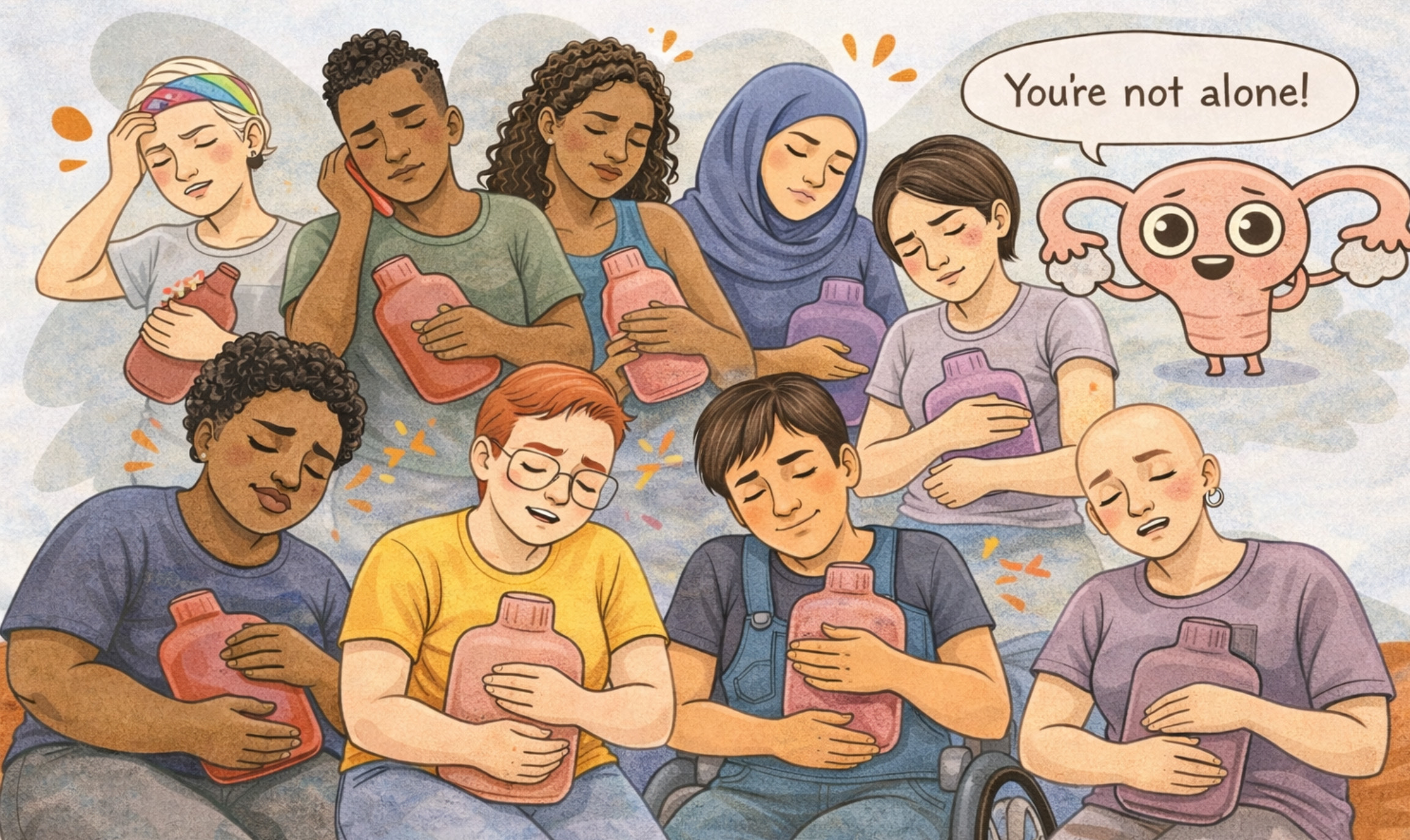
(Artwork by Arina Grosu from our Patient and Public Involvement and Engagement panel)
Support from friends and peers, especially those who menstruate, was often important for young people in managing their periods and period pain. this section covers:
- Emotional support could help people feel less alone in managing periods
- Online emotional support
- Sharing period products and pain relief
- Checking for bleeding and leaking
- Sharing information and advice about periods and period pain
Emotional support could help people feel less alone in managing periods and period pain
Learning that periods and period pain were part of a “shared experience” (Abi) and that they were part of a “community” (Emily Z) could help young people manage them. As Bella explained, “we’re all just here, there to support each other”.


Finding peers and friends who were also having periods could help people feel “not alone” (Ela). It could be difficult when people were first starting their period, especially for those whose periods started when they were quite young, as not everyone around them had yet started. However, as time went on and more people also started their periods, young people appreciated being part of an “unspoken community” (Ela).
When Reham started her period, she realised that a few other people she knew also had periods, which helped because “it felt like I wasn’t alone, and it had like a group to it”. For Abi, who started her periods after many of her friends, this meant that she was initially “really excited for it to happen, it’s like I’m finally part of the club” – although for her the reality of periods and period pain meant that this excitement didn’t last long.
As well as solidarity from knowing that they were not alone, young people we spoke to found that being able to let others know created opportunities to then receive support. Jian explained that, at her school, “it was just easier ’cause like if you’re having a rough day, it’s a period day, then you just let it be known, and then... and there’s... there’s a lot of like empathy going around, a lot of support”.
Eidra found the solidarity of sharing menstrual experiences very “bonding” and that the kindness of people in sharing learning and giving support was “quite lovely”.
Eidra found the solidarity of sharing menstrual experiences very “bonding” and that the kindness of people in sharing learning and giving support was “quite lovely”.
It was kind of like a little bonding experience actually, you know, ’cause you all go in the bathrooms and you all chat about it and you all give... I do think like growing up, like young girls, we do... they are very open and we do actually talk about women’s health quite a lot. So, I think, I don’t know, that I think that’s really sweet. I never felt like alone or like it was just me that was going through it.
OK. So, would you say that... was that quite an important part of the...?
Yeah, a hundred percent; a hundred percent. I think... ’cause I think as well, like getting your period, especially when you’re so young, like you do feel like you’re finally turning into a woman and it is something that like little, you know what I mean, girls always like talk about, and it is like a little... it’s almost like a bonding thing ’cause you know everyone goes through. Even if you’re like just like going out and you like haven’t got a tampon, like everyone’s always like willing to share and, you know, so I think that’s quite lovely.
Moving away to somewhere new, such as going to university, could make it more difficult to get emotional support around periods and period pain. It could take time to build these types of connections and friendships.
Hannah found managing her period pain difficult when she first started university, because she didn’t know people well so it felt a bit “isolating”. With time, she has made good friends which has helped.
Hannah found managing her period pain difficult when she first started university, because she didn’t know people well so it felt a bit “isolating”. With time, she has made good friends which has helped.
How has starting uni been with having to kind of? has that been tricky to manage when you've been away from home?
Yeah, especially because it's got really bad since I've been at uni, it's been quite hard because it like, knocks me out for at least a day and I can't. I don't have my Mum and it's like friends. I've only just met. It's quite hard because I'm just like stuck in a room on my own being like this. It's got like, it's better now because I've got a good group of friends and stuff, so I don't mind it as much, but especially in like the first time it happened was a bit isolating. She's still. Yeah. So, it's not been great.
While shared experiences could be a source of support, it could be a bit confusing when people had period and period pain experiences which seemed quite different to those of their friends and peers. Liv, whose period pain started at primary school, found this mismatch of experience “quite isolating”: ‘I couldn’t really talk to my friends about it either, because I didn’t know if it was normal or not, and some of my friends have... they... obviously, all my friends have their period [now], and I couldn’t share my experiences with them because I didn’t have the same experience, so I couldn’t talk to them about it and say, “Right, do you get this, and do you know what... or anything I can do, or...?” I could just help them, they couldn’t... like no-one could help me”.
Rahma doesn’t really get marked period pain. When talking to her friends, this could leave her feeling confused and a “bit left out” (read by an actor).
Rahma doesn’t really get marked period pain. When talking to her friends, this could leave her feeling confused and a “bit left out” (read by an actor).
Yeah. And what... did you ever have to leave any lessons, or did your friends ever have to leave any lessons, or kinda talk to teachers?
Mm, I think because my experience, I felt that maybe I was a bit left out, because my experience of period pain was not severe at all. It was just the occasional cramp or the occasional uncomfortable, but I never suffered any of this, oh, my God, it’s like you’re being stabbed 10 times, like I’ve never experienced that, so I thought, ‘oh, OK, so am I a bit more lucky or just healthy?
And... and one of the things that I got really, really interested in is about how people get that sense of comparing, how people make sense of their periods compared to other people’s, and how much they talk to their friends. I don’t know if you have any thoughts on... on?
I think... I think a lot of people, especially when you’re young, you want to fit in with the people around you, so sometimes if you feel like your experience does not match up to other people, you feel a bit left out and like: ‘oh, is there something wrong with me, or is... is there something wrong with them, or...?’ you know? But for me, I think a lot of it was just confusion because I thought that I didn’t have everyone else’s experience, so maybe my period was just... I would often dismiss my period a lot because I’d be like: ‘OK, well, mine’s never been bad, so I can’t complain,’ yeah.
Online emotional support
While much of the solidarity we heard about happened in local settings, like school, sports clubs, or social clubs, online communities could also be an important place for connection and companionship about periods and period pain.
For Zaynah, online communities, like on social media, were a place where she found people who could “understand that my pain was real and that I should be listened to and that their reasoning isn’t completely valid of me being too young”. Online communities and social media were also important to Ivy: “it was actually nice to... it made me… less lonely because for the first two or three years on my period I felt so alone in it and I thought it was just me having those pains, but actually it’s not”. [See learning about periods and period pain: Finding information beyond school lessons].
Another online way of feeling part of a community or connecting with other experiences of periods and period pain was through interactive apps, like menstrual tracking apps.
Lily found the 'secret talks' on her tracking app supportive during her periods and pain, connecting her with others with similar experiences. These shared insights also helped her decide to give hormonal contraceptive treatment "a go."
Lily found the 'secret talks' on her tracking app supportive during her periods and pain, connecting her with others with similar experiences. These shared insights also helped her decide to give hormonal contraceptive treatment "a go."
What sort of things made it feel like a good website to look at for you, if you see what I mean?
NHS websites I think were... were really important to... to look at because they are... they are trusted throughout the whole of the UK. And I definitely did... did look at the NHS website and sort of... I also used the Flo app, and they have like secret talks on there about their experiences, so I would sort of... it would come up on there like what pad should you use, what’s helpful. And so that also did bring me to the whole world of periods and sort of helped me through... through all of it, I guess.
Yeah, yeah. And the Flo... the chat that you were accessing on Flo, which is also something that actually I really wasn’t expecting that I’ve... that I’ve heard from lots and lots of people about, is that... and that’s the chat function that... where people post the kinda Q&A board, is that right?
Yeah, yeah, that’s correct.
And... and that was something that you found really helpful?
I think it was probably one of the most helpful things because you would see sort of... you’d worry about abnormalities with your periods and you would see, you know, you’d... you’d search up: “Is this normal in my periods?” or, “has anyone ever experienced this with their periods?” and then you would sort of look on that chat and see other people’s experiences and you’d go: ‘oh, right, OK, it’s normal,’ or, ‘this other person’s experienced it, so I’m not alone in this situation.’
OK. And what sort of things were you kinda wanting to check out whether it’s normal or not? You talked about heaviness of bleeding. Were there other things that you worried about or was that the...?
Period pain as well. Obviously, I... I found out the root of like endometriosis and... and sort of, you know, it’s not normal to feel that much pain, ’cause I... I did have a lot of horrific experiences with my periods in the past.
OK. OK. Can you tell me a bit about the pain that you’ve had with your periods, kind of, was it always there when it started, and... and what you kinda thought, what you... but yeah, what you thought, where you looked for information, or anything like that?
I think before I started using Flo, or before I went on those secret chats, or where... I... I would be sort of on the floor in pain feeling really, really sick, and like I couldn’t go to school because they were so painful. And I just thought that was normal, to be honest. I just thought that’s sort of how... how everyone experiences period pain – but appar... apparently not – because I... and compared to others, I did compare to others and so... “Do you experience this?” like: “No,” so I just thought I was a bit unlucky really with... with my period pain.
— from websites? Or were you given any other links?
I did have a look on Google and sort of those sort of links. And the NHS website I did look at. And it does come up with the side effects. And you sort of read the statistics on those different apps and you sort of level out: ‘OK, what’s the likelihood of this happening to me?’ And you sort of weigh that up and you think, ‘I’m in pain. I need to regulate this. I’ll just try it.’ Because you’d... you’d sort of weigh up the statistics on websites and... and Flo. I definitely did look at Flo with all of this, and I... I saw that people were still recommending it, even though you had all of those side effects, and I just thought, ‘if these people think it’s all right, then I’ll give it a go.’
OK, brilliant. But you think that that is a worry for lots of people?
Yeah. I think if... if we didn’t have access to the internet and support from other people that are online with the same experiences and worries, I think we’d all be a lot more worried and a lot more anxious about... about these sorts of things, definitely.
Yeah. So, it’s actually, that’s been a massive source of comfort for you?
Yes, yeah.
Sharing period products and pain relief
Dr Katy Vincent explains that over the counter painkillers can be effective for period pain and are safe for most people, but need to be taken in line with the guidance. This means they should not be shared with friends to make sure they are taken safely.
Dr Katy Vincent explains that over the counter painkillers can be effective for period pain and are safe for most people, but need to be taken in line with the guidance. This means they should not be shared with friends to make sure they are taken safely.
Painkillers can be really helpful when you've got period pain, and we would absolutely encourage people to use painkillers. And it is really important that we use them safely. So, the dose that you can take all the time between doses will vary depending which type of painkiller you're using.
And it's important not to share medicines between you and your friends. We know that happens all the time because it's really hard to get around how you can take these medicines at school, but systems at school should be set up to allow you to take medicines safely, and you need to understand what that system is within your school and get your parent, or your teachers or the school nurse on board to really help you set up a way of making sure that you can take medication when you need it, but that you're taking it safely and not sharing it with your friends.
Most painkillers are really safe for everybody. You can buy them over the counter, in the supermarket, in the chemists. You wouldn't be able to if they weren't safe drugs. But there are some people that can't take these drugs for specific reasons. So, it is really important that you know that the painkiller you're taking is safe for you and for that reason, you should only take medicines that are yours. You shouldn't borrow medicines from your friends, but also you shouldn't give your medicines to other people just in case they might not be safe for them either.
Young people also offered and received practical support from each other to help with managing periods and period pain.
This included sharing products for period bleeding, with friends or with anyone who needed one. Emily X, whose school ran a free period product scheme reflected that she “used to be shy about asking for period products in school and relied on my friends’ products”.
Many young people we talked to said they always carried a supply of period products with them, just in case they or anyone else needed anything. This was often accompanied by a sense of community responsibility, pride and kindness – as well as recognition that they themselves may one day be short of a period product and need to borrow one.
Elsa would be “devastated” if she started her period and didn’t have any products to hand, so she would always happily give pads or other products to anyone else who might need them.
Elsa would be “devastated” if she started her period and didn’t have any products to hand, so she would always happily give pads or other products to anyone else who might need them.
You said that you have that constant kinda awareness that they might start and you’re always thinking about it, but... that... and so you’re always carrying things, but you also said “and also for other people”, can you tell me a little bit?
You know, just think it like, at school maybe if somebody’s started and they don’t happen to have any pads, it’s, you know, like if I was... if I’d started and I didn’t have anything, I’d be devastated. So, it’s like, even if I don’t know the person, like I would happily give them pads, or whatever.
And in your experience, was there a network of that happening at school that you kind of look after each other?
A little bit.
Yeah.
Yeah. Like, girls that I hadn’t spoken to in ages would ask if I had pads. Girls that I didn’t speak to at all would ask if I had, like, painkillers for cramps and stuff, and it was sort of like: “Oh no, sorry, I don’t, but I know that this person probably does.” So like it is nice that we all sort of try to look after each other.
Yeah. Would you... would it tend to be with people your own age or just... or did you feel like-
Honestly, I probably could have asked anyone, but in my ex... just from my school’s, people only rui... really tended to talk to people within their year group.
Jade described how: “I’ve got pads and painkillers and tampons, and stuff, but I bring like loads ’cause people ask around – that’s the thing – people go: “Anyone got this?” and I go: “Right here.”…I haven’t seen many other people bring... bring in a lucky bag, but, you know, I do, just ’cause not everyone... sometimes people have an unlucky day where they forget to bring something in. They’re not gonna... I’m not gonna make ’em suffer for it’. As Jian remarked, people are understanding and you can ‘like go up to any female and ask for a pad, I’m sure they’ll have plenty on hand’.
Emily says she regularly carries period products and will happily share whatever people might need.
Emily says she regularly carries period products and will happily share whatever people might need.
We tend to complain to each other quite a lot when... when we’ve got quite bad cramps, we’ll say to each other: “Oh, it really hurts.” But within my friend group, like even if they didn’t want to go to the office, I’m usually... I’ve got like lots of stuff in my bag, and if they need anything, I’ll like quietly slip them something if they need it.
Mm, OK. Brilliant. So you... you can... you’re... you’re kinda supporting each other within that network?
Yeah, yeah. And if people are too afraid to go to the office and go and ask for things, I know that it happens. I definitely feel throughout my year group, for sure, people give each other things; it’s... it’s quite lovely, really
Some young people also shared ways of helping manage period pain with each other. This included at school where it could be sometimes be difficult to get pain medications through official routes [see school support and managing period pain]. Abi explained how “between us, everyone, we’d... one... someone would always have like ibuprofen or a paracetamol on them that you can take, and they were always really understanding”. Elsa described “stocking up on …what foods make their cramps worse or better” for her friends when planning get togethers, so that her friends would be more comfortable.
Reham talks about how “girl power” means that they all have “each other’s backs” when managing periods and period pain, including sharing products and things for period pain.
Reham talks about how “girl power” means that they all have “each other’s backs” when managing periods and period pain, including sharing products and things for period pain.
Like if anybody needs help, since I’ll have a lot of friends, right, so if anybody of them needs help, everybody’s got each other’s backs, like even if you’re not friends, like we’re still gonna help you out, just to, you know, girl power.
And what sort of things do you do to help each other?
A few times some of us have snuck in like paracetamol at school or like just painkillers for the others. And sometimes we’d... One of us usually has like... and just a water bottle, like a warm water bottle that we can just put on abdomens. And we also have... nearly always have pads in our bags like all the time, so if anybody needs one, or anybody needs a tampon, which I usually carry, but if anybody does have a tampon and somebody else needs it, like and we’ll be OK giving it out, of course, like.
So, you’ve got a kinda girl-power solidarity?
Yeah, definitely.
And you share menstrual products and you can talk to each other, and you’re basically looking out for each other?
Definitely.
And you said some of you might bring pain relief in: is that ’cause you... is there differences in who can get access or who... who’s kinda likely to have it?
Most of us... well, the ones that do bring it, I wouldn’t like to snitch, but whoever does bring it, like usually they’ll say it’s because they’re really, really, really ill, and the school might let them get away with it, and they just give it out to anyone who actually needs it.
And that’s usually for period pain?
Yeah.
But you don’t think your school give out pain relief for period pain?
Not really.
Checking for bleeding and leaking
Another type of support young people gave each other was in monitoring for visible leaking or bleeding. As Lucia explained, “my friends also like always say, “Oh, can you check me, can you check?” So yeah, I think everyone would have that as well”. If someone did leak, friends could ask teachers for help or explain what support was needed, help clear up and suggest ways to make the young person more comfortable, like wearing a jumper around their waist.
There were other practical ways that young people and their friends supported each other at school. Scarlett explained how she had helped a friend get to the first aid office for period pain: “I’ve done that for one of my friends. I helped them over to First Aid whenever they’ve had bad period pains, inside the hall for assembly’” Sage told us how her friends know she vomits with bad period pain, so “it’s like I don’t even need to explain, I just go to the bathroom, and they’re like: “Someone should go check, make sure she’s not throwing up again.”’” Her friends also help her with catching up on school lessons when “sometimes I got like, not really be there mentally in class ’cause I’m sitting there in pain, so I’ll just like ask my friends for notes”.
Sharing information and advice about periods and period pain
Young people also supported each other with guidance and advice about periods and period pain. Those who had started their periods might almost mentor friends or siblings who had started after them. Scarlett explained how “one of my friends, she first like took her first period in Maths randomly, so me and a few of my other friends had to, you know, give her advice’”. Candice appreciated being on the other side of that peer support when she started her periods after most of her friends and was able to turn to them for advice and information: “most of my friends hit it way before me, so like if there was something wrong, I’d just go to them and I’d say, “Oh, do you have this? What do I do with this?””
Rosie looks out for her younger sister in school, and tries to be there for her when she asks for advice as well as supporting her with products at school.
Rosie looks out for her younger sister in school, and tries to be there for her when she asks for advice as well as supporting her with products at school.
Now, I think... well, there’s only one younger girl in my family, but when I got my period, she was quite scared ’cause she didn’t know what to expect, and I was just like... Well, whenever she has cramps, or whatever, she comes to find me in school and I give her paracetamol, or whatever, or... and she always knows that I have pads on me so that she can come to me. But it’s not like... and it’s never been presented to her as like something that’s a coming-of-age moment, because I don’t think it is, and it shouldn’t be treated as such. But yeah, she was like: “Can you give me advice for when I start my period?” and she’s like quite a few years younger than me, and I was just like a bit confused. ’cause I’ve never understood why it was treated like that, or why, you know, anyone look forward to it, so I just thought it was a bit scary.
Not everyone had felt confident, comfortable or ready to offer advice about periods to others though.
River started his periods before many of his peers. He and his mum explain how being asked questions about what periods were like and how to manage them could be a bit awkward (read by an actor).
River started his periods before many of his peers. He and his mum explain how being asked questions about what periods were like and how to manage them could be a bit awkward (read by an actor).
Mum:—and they don’t want to scare them. So, it ended up, you became kind of like the agony aunt of sex education—
River: Yeah.
Mum:—when you didn’t want to be that person.
River: Yeah.
Mm, yeah, so people would come and ask you for advice?
River: Yeah, they... they always ask me things like: “Does it hurt?” Like... oh, like: “What do you use, like, pads, tampons?” whatnot, like, stuff like that.
Mum: All the normal things that you... if you were a kid who hadn’t had them... which again, would you say it was a bit awkward?
River: Yeah.
Mum: You didn’t... you didn’t really sign up to be that person.
River: Yeah.
How... did that change over time as other people started their periods? Can you kind of...—
River: It... it...
—what happened then?
River: —yeah, it was only once I got to secondary school where I met other people who had already started their periods, and so then I didn’t feel so weird.
Yeah. OK. So... so that helped as other people kind of—?
River: Yeah. ’cause then you could just talk to each other about like different experiences.
Some young people, like Reham, had experience of friends noticing that they were struggling with period bleeding and pain, and encouraging them to go and see a doctor. When Reham started fainting in class, they messaged her saying “this is not normal, get your butt to a doctor”. Willow’s best friend encouraged her to go easy when dealing with her period and period pain, because “she was just worried about me”.
You can read more here about how parents, siblings and other family members also gave emotional, practical and informational support around periods and period pain, and how school teachers and wider staff could give support.
Copyright © 2024 University of Oxford. All rights reserved.