

Young people's experiences of periods and period pain
Describing period pain
How young people approached explaining their period pain depended on who they were talking to and why they were describing it. For example, they might be explaining their period pain to friends or family, share experiences, give and receive support, or help make sense of their symptoms. Most of the reflections we heard specifically about trying to explain pain were in the context of talking to healthcare professionals. Young people might also need to explain or describe period pain when asking for help or advice at school, for example if they need to leave a class. This section covers:
- Period pain as difficult to explain
- The different words used to describe period pains
- Describing period pain through the impact it is having
- The pros and cons of trying to measure or compare pain
- Being listened to and having pain heard
Dr Katy Vincent explains that there are different ways to explain pain, and use what works for you. It can be helpful to have notes or practice before an appointment. You don’t need to say everything at the first appointment, you can go back.
Dr Katy Vincent explains that there are different ways to explain pain, and use what works for you. It can be helpful to have notes or practice before an appointment. You don’t need to say everything at the first appointment, you can go back.

People often wonder how they're going to start a conversation about pain. Because pain is such a personal experience, it's really difficult to put it into words. But I think anything that you find helpful to tell your story is what we want to hear. So, you might describe pain in terms of how intense it is, the number that you would score it at.
Or you might describe pain in terms of the emotions or the sensations that go with it, or the words that come to mind. On the other hand, it's really helpful for us to understand what bits of your life it gets in the way of, because actually, it doesn't matter how strongly you score it, if it stops you doing the things you want to do, then that deserves treatment.
If you're struggling to think about how, you might start that conversation, why don't you write down on a piece of paper what you want to say to us? Or, practice talking about it with a friend or with your mum or your sister before you come. So, you feel really confident in telling us the message that you want to get over.
But if you find that you can't get the story over in the first appointment, you can always come back and tell us again. You don't have to tell us everything the first time you come to see us.
Period pain as difficult to explain
For many young people we talked to, there was a feeling that period pain was “hard to describe” (Chloe) or “tricky” to explain (Iris). As Bella Z said, pain in general is “quite hard to like describe to someone, like and you don’t know it until you feel it”. Jade also felt that talking about pain could be difficult: “I’m just not very good at like describing like feelings, and stuff. Like if I’m in pain, I can’t tell you like if it’s stabbing or something like that, I just know it’s pain”.
Jayden has worked out how to describe his back pain, but finds period pain really difficult to explain because of how it feels and because it fluctuates.
Jayden has worked out how to describe his back pain, but finds period pain really difficult to explain because of how it feels and because it fluctuates.
I do still think it’s hard to explain how bad it can actually get because it’s the only... yeah, and I don’t know, and I do think it is hard... you can convey how... how bad it can be because anybody has like that sort of pain at all time, but it’s like it’s extreme. I guess, well, for... for me, obviously some people... I know that people that probably have it, prob... it’s probably more painful than for other people, but... Yeah, no, and like I say, it’s just so hard to try and explain the type of pain because it feels like a specific source, and it just feels like unique to what it is. And like I said, it’s just, yeah, like ’cause I mean I have like backpain anyway, so it’s... and that’s always constant. I can explain that a little bit more, but when... yeah, I don’t... I don’t know, like I said, I can’t explain it, and you just have to kind of see me in that sort of moment to understand, yeah, and it is bad.
Do you think there’s anything about how it gets heard? Like it’s hard to explain...
Oh, no, yeah. No, I... yeah, and it is just hard to explain ’cause it... like I don’t know, it just feels like you can’t put your finger on it a little bit. Like, yeah, and I... I don’t know. Like I can... ’cause it... like I say, like with like my backpain I know with that it’s like nerve pain, or sometimes I just like feel stiff, I can explain that all right, I can pinpoint, you know, where it is, what causes it, or something, but it’s sporadic. It’s not nerve pain, but it’s not exactly muscular, so I don’t know what else to kind of like call it. It can fluctuate, and like I said, it just... it’s not constant, it just happens with like an hour like time period, so... Yeah, and because of like the way that I am, sometimes it just also feels like I’m just exaggerating a little bit when I say I can... like I get like lightheaded and I threw up before, it like makes my legs feel horrible and I can’t like do much. It just feels like... like I’m over-exaggerating a little bit as well because it’s like: “Oh, well, you... you should be used to it, it happens all the time.” And it’s like: ‘yeah, but that doesn’t make it... and that doesn’t make it less painful.’ In fact, like I said, it feels like it consistently gets worse each time.
Chloe and Lola thought period pain was hard to describe partly because it didn’t obviously feel like other things they had experience of or could compare it to, because “it’s not really like banging your elbow or anything” (Chloe) and “I didn’t have a way to describe it to them ’cause I couldn’t be like: ‘Oh, it feels like if you pull a muscle’” (Lola). Some young people had come across others trying to explain how painful periods could be by comparing them to other things known to be painful, like a heart attack (Elsa), childbirth contractions (Liv) or being “kicked in the balls” (Sarenna).
Another aspect that could make it difficult to describe period pain was that, for many, the pain can vary a lot in the same cycle and between months. Sarenna explained: “it kinda changes, like there’s not really one answer, so it’s just a difficult question to answer”. Emily talked about not thinking about her period cramps, between episodes of pain, making it hard to explain: “It’s almost, I forget how painful it is until I actually have cramps…It’s quite hard to describe something that you’re not experiencing, so it was quite a shock to me that they were that painful and that bad”.
Zaynah thinks describing pain is difficult, because the type and extent of her pain varies quite a lot through the month.
Zaynah thinks describing pain is difficult, because the type and extent of her pain varies quite a lot through the month.
And did you ever kinda get asked to do a kinda scale or... or one to 10?
Yeah, a scale of one to 10. But I feel like that’s also quite hard to do because pain varies quite a bit, and if you’re always in pain, or like across your period and... So, like the... the week of your period and like a week where you don’t have your period, I feel like the scale can be completely different, because on your period you’re also dealing with blood, which can make the scale go like... go beyond 10, and then a week without your period, like maybe the scale stay... the scale stays within 10, like, yeah, I... I feel like it’s quite hard to do.
Yeah. So, describing pain is quite difficult?
Yeah, I think so.
The different words used to describe period pains
The word ‘cramps’ was often used to explain period pain. Rahma recalled hearing the term when learning about periods in school: “I think it was mentioned as just cramping, but that was called the symptoms, I guess, was cramping, and that’s about it”. When Iris talks to her friends about period pain, “we’d kinda say, ‘Oh, gosh, I’ve got really bad cramps’”. If talking to a doctor, Bella Z “would say it’s cramps, and then they just kind of understand”.
Lucia describes period cramps as ‘a uncomfortable pain’ in the lower stomach.
Lucia describes period cramps as ‘a uncomfortable pain’ in the lower stomach.
Mm, I actually remember I had like for two months, then it stopped for a few months, and then it came back, but it wasn’t that bad, like not heavy or anything.
And not painful?
Yeah.
OK. But you said they’ve changed since then and they’ve got kinda worse. Can you...—
Yeah.
—can... yeah, can you tell me a bit more?
Well, like recently I’ve got more like cramps, but I used to like never get them; I think I jinxed it by me saying I never got it. But yeah, and then recently I have.
OK. And when you say ‘cramps’, what... what does that kinda feel like; how does... what do you notice?
It’s like a uncomfortable pain, like in the lower stomach.
And when you have the cramps, how do they kinda impact on you: do they... how do they [erm] make you feel?
I’m not really sure, just it feels like a tummy ache, so just forget about it.
OK. Do they ever stop you doing anything?
No,—
No.
—not really.
OK. How... when... if you have your period during school or... or during your exams, or anything like that, will it... does it have... make a difference to how you feel?
Not... just a bit annoying, like not really affecting me, but just a pain.
While ‘cramping’ might cover all about period pain to some people, the word could mean different things for others. This could make it tricky to compare experiences. Scarlett described her idea of cramps and other types of period pain, saying: “I don’t really think that there’s a way to describe period pain in general, ’cause everyone has different sensations whenever it comes to it. Some people will get really bad stabbing pains and some people will just get like quite bad, you know, cramps, you know, like tensing of the stomach”. As Liv said, “it is really hard to explain what the pain feels like, because unless you can feel it as well, you can’t explain it. It’s not something you can go: ‘Oh, yeah, it... it just feels like a period cramp.’ Like, but what is a period cramp? Like what... how... what does that feel like”.
Eidra thought having period pain was normal. She felt this was reinforced by the reactions of people around her, including friends, teachers and school nurses. She worries normalising period pain might seem to ‘downsize’ it so people don’t ask for help.
Eidra thought having period pain was normal. She felt this was reinforced by the reactions of people around her, including friends, teachers and school nurses. She worries normalising period pain might seem to ‘downsize’ it so people don’t ask for help.
I think they need to tell people, like show them if you’re experiencing this amount of pain, then you do need to go get help. Because the fact that that was so normalised, like really, that really shocks me. And I think they should talk more about like... ’cause it’s not healthy to be having painkillers all the time. So, I think they should talk about more natural pain remedies and that should be like more taught, like that should be more mentioned and taught about in school.
Yeah. And that’s really interesting what you say. So, your sense was almost that being in that much pain was normalised?
Yeah, a hundred percent. Like I didn’t... as I said, until recently, I did... I thought that every single person got like period cramps and I thought bad period cramps were the norm, and that’s not... like that’s not right.
No. And do you... I know this is probably a really stupid question, but do you kinda have any sense of where you develop that idea that it... that that was the norm? ’cause like, it’s quite hard to know, isn’t it?
I think it’s like a variety of like talking to other girls who also like complain that they’ve got really bad period cramps. Talking to your teacher and then the teacher being like: “Oh, and it’s just bad period cramps.” I think like there is like this general consensus that it is just like a bad cramp or a bad pain and it’s never like shown that actually this isn’t... yeah, this is too much.
And especially with my migraine thing actually, that... like I... I thought that was normal for a long time, and that was not... like that was debilitating and that was not normal. And not everyone got that, but no one like mentioned it. Like if I told the teacher, for example, like: “Oh, Miss, like I’ve got... like I get really bad migraines on my period,” like she’d just be like: “Oh, that’s kinda normal, everyone gets a headache,” you know? So, like these things weren’t like... I went for years and years without like going to the doctor or like noticing anything, so... yeah.
And so that kind of: “Oh, yeah, no, that’s normal, that’s normal,” that can happen?
Uh-huh.
And you said that... did that kinda factor into how you may... like how and when you felt kinda able to think, ‘well, maybe I’ll go and see a doctor’?
Oh, yeah, I think a hundred percent; a hundred percent. I think if I’d have known sooner, I’d have like gone to the doctor sooner. And I think it’s... But yeah, yeah. I go to like the nurse as well. I think that maybe she’d said something like: “Oh, and maybe you should...” ’cause I went to the nurse... and I think a lot of people went to the nurse, but I went to the nurse like quite repetitively around my period and she... she would... she would like just send me back to like class, or if it was really bad, send me home, but she never said go to another doctor and get this checked out, you know?
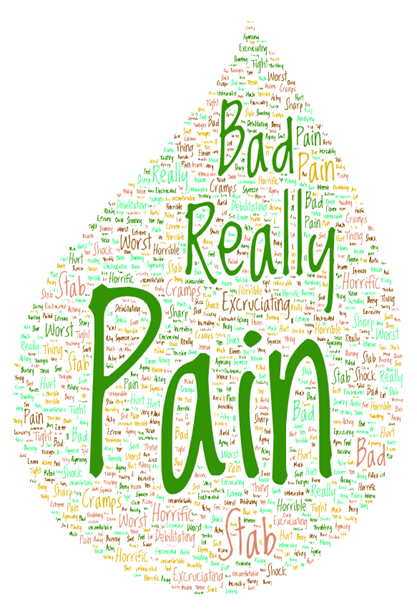
Many of the young people we spoke with used descriptive words and expressions to try to capture how their period pain felt. Words to describe the extent of the pain included “really bad” (Rosie), “debilitating” (Lola), “horrible” (Bella), “horrific” (Liv), “owie” (Leila), “unbearable” (Emily Z), “agonising” (Sage) and “excruciating” (Anayaa). Abi said hers was “ten out of ten, like the worst thing ever”. Some people said they were “lucky” (Jian) to have milder period pain, which was “uncomfortable” but “not extreme”. (Rahma). Elsa described her experience as “sort of like twinges every now and then and maybe some like tightness. More... it’s more that it... I sort of ache”.
The words young people used to describe the period pain itself included things like “stabbing” (Scarlett), “throbbing” (Emily), “pulsing” (Anayaa), “a tight squeeze” (Bella), “tense” (Candice), and as a “bad spasm” (Jayden). Bella described period pain as a “sharp, swift sort of pain and kind of like being electrocuted”. These pains were often in the lower abdomen (bottom of the stomach or pelvic region), but also could be felt in the legs, back, and bum. Sometimes the ways other people described their period pain didn’t make sense to young people, as Iris explained: “my mum’s sort of feel twisting wires didn’t... don’t really relate to my period cramps at all”.
This image captures the words young people used to describe their period pain.
Describing period pain through the impact it is having
A number of young people felt that a helpful way to talk or answer about period pain was to explain how it impacted on them. Sarenna suggested: “the doctors asking so like maybe: ‘What has it stopped you from doing?’ or something like that, because then maybe if they asked that, then they could probably kind of get their own ideas of how much”. Iris felt that her GP “definitely got a good picture when I described that how they affected my lifestyle”. Hannah X felt that it was “very easy to explain what it stopped you from doing rather than specific... ’cause, I mean, it just hurts in my stomach. It’s... it’s much easier to explain what it stopped me from doing and much clearer to get across how bad it is by saying that”.
Rosie thinks it is hard to “convey” pain, so instead she explains that she faints and vomits and is bedbound when she has period pain.
Rosie thinks it is hard to “convey” pain, so instead she explains that she faints and vomits and is bedbound when she has period pain.
And so... so how did you find explaining the pain and... and...?
I can’t... usually when I’m asked about it, I’ll just explain like the physical symptoms, rather than like how painful it is, because you can’t really convey pain to somebody. But also like, I guess, it’s less believable, or like it du... you can’t conceptualise how much it hurts, least of all if you’re a man. So, I tend to sort of say that I faint and vomit and I’m bedbound rather than I have really bad pain, because like physical symptoms are more likely to like get you listened to. Yeah, so that’s what I explained to the GP.
The pros and cons of trying to measure or compare pain
Some of the young people we talked to described ways that they had tried, or been asked, to measure their pain in some way. This included pain scales and ‘average’ pain.
Zaynah thinks pain is a “weird” concept, and that how people feel and talk about pain can be completely different. She has found this difficult in healthcare appointments.
Zaynah thinks pain is a “weird” concept, and that how people feel and talk about pain can be completely different. She has found this difficult in healthcare appointments.
Yeah, exactly, because I just feel like one person’s way of describing pain can be completely different to someone else’s pain, and both of you can be experiencing the same pain, if that makes sense?
Mm.
Yeah.
And I think you’ve touched a bit on trying to explain your pain to other people and trying to feel heard, but I don’t know if that’s something that you’ve thought about at all? It’s obviously something you’ve... you’ve had a lot of—
I think... yeah.
—kinda experience around.
Yeah, I just... I just think pain’s a really weird like concept. Like I’ve come to like just decide that pain is a weird concept and like... like I just... I’m not... and I still don’t really know how to explain it because I feel like from my first gynaecologist appointment, the first thing you need to be able to do is explain the pain that you’re having, and where it is, and what it’s affecting, and how long it lasts, and things like that, and I feel like that can be really tough because if you’re in constant pain too, like explaining it is a bit like... like I don’t know how to do that. Like I just... like it’s quite tough, and... yeah.
And it sounds like it’s something that you found quite worrying.
Yeah, exactly. Because I feel like as well like sometimes you think that there’s a set answer, and if you don’t give that set answer, they won’t believe you, or they think that you’re faking it, or like you’re making it up on the spot, if that also makes sense?
Mm, mm.
Yeah.
Some young people had encountered pain scales, usually when speaking with doctors. These typically ask people to express their pain on a scale of one to ten, with one the least and ten the most pain. Sometimes they are verbal (asked as a question), and sometimes they are a picture scale (with numbers or smiley faces).
While some people, like Iris and Lucia thought this might help them explain pain, others were not so sure. As Bella explained: “I don’t think there’s a good way that you can actually measure pain ’cause it’s all variable and individual”. Even with pain scales, Hannah X thinks that “it’s not very easy, just, I guess, because it is so subjective. Yeah, yeah, I guess it’s always gonna be hard to describe pain”. Eidra was asked to rate her pain on a 1-10 scale and found that for her “it’s quite hard to put a pain like on a threshold, ’cause there’s different types of pains. So yeah, I didn’t... I don’t know if the answer I gave was completely accurate to me”. Jade also thought she would find putting her pain on a scale difficult because “I feel like sometimes I could just throw a number out there ’cause I don’t... It’s hard to imagine it on a scale if I don’t know like what the worst it could be is, ’cause it could feel like it’s the worst thing in the world right now, but it could probably get worse, and I wouldn’t know”. Zaynah sometimes felt like “sometimes you think that there’s a set answer, and if you don’t give that set answer, they won’t believe you, or they think that you’re faking it, or like you’re making it up on the spot”.
Zaynah thinks describing pain is difficult, because the type and extent of her pain varies quite a lot through the month.
Zaynah thinks describing pain is difficult, because the type and extent of her pain varies quite a lot through the month.
And did you ever kinda get asked to do a kinda scale or... or one to 10?
Yeah, a scale of one to 10. But I feel like that’s also quite hard to do because pain varies quite a bit, and if you’re always in pain, or like across your period and... So, like the... the week of your period and like a week where you don’t have your period, I feel like the scale can be completely different, because on your period you’re also dealing with blood, which can make the scale go like... go beyond 10, and then a week without your period, like maybe the scale stay... the scale stays within 10, like, yeah, I... I feel like it’s quite hard to do.
Yeah. So, describing pain is quite difficult?
Yeah, I think so.
Lily appreciated that her doctor didn’t ask her to rate her pain. She offered her options for treatment and arranged follow up, which helped her feel confident in the care.
Lily appreciated that her doctor didn’t ask her to rate her pain. She offered her options for treatment and arranged follow up, which helped her feel confident in the care.
I think it was because she didn’t ask me a bunch of questions, you know: “How... how high is your pain tolerance?” or, “on a scale of one to 10, how do you rate your pain?” Didn’t ask me any of that. She just... she knew that I was in pain and that she didn’t feel like she needed to ask me those questions of my pain threshold. And she just thought, ‘I’ll try you on these, see how you feel, let me know if you have any problems. We’ll take you off whenever you need to. Let me know if they work.’ And I think because she was so helpful with that, it made me more confident and more relaxed that... that I was getting the help that I needed.
Brilliant. And also that you could go back if it didn’t help.
Definitely.
And would you... would you feel... you’d feel happy to go back?
Oh, definitely, yeah.—
Yeah. I’m really interested in what you said about pain scales, ’cause actually one of the questions on my guide is, has anyone ever asked you to describe your pain? And I guess there’s two aspects to that: one is whether you find it helpful or easy, but the other is how it kinda makes you feel? Do you... and... and it... they obviously had quite an impact on you, the pain scales, kind of—
Yeah.
—describing pain, so I don’t know if you’ve got any thoughts on... on that, but... but... but I’m... [erm] think that’s a really interesting observation.
I think because it’s like: ‘oh, if your pain’s not... not that painful,’ which is a silly thing to say really, because pain is pain, obviously there’s just different levels, of course. But I think any pain to do with periods, it sh... it should just not be overlooked, and it shouldn’t be overlooked at all. And so a scale, it’s hard to... it’s hard to pinpoint with... with pain, because you could be stabbed, and it’d be a 10, but you could also have horrific period pain and it’d be a 10. It’s obviously hard to differen... differentiate that pain in relevance to other things, not to do with periods, yes.
Yeah, no, I... I agree. And... and it seemed to have quite a strong... So there... there’s the fact that it’s quite hard to know what to do with it, but it seemed to kinda cause quite a kinda emotional response in you as well, that kinda: ‘can you describe your pain?’ I might have... No, du...—
Sorry?
—does it kind of... yeah, did it... it sounds like it was something that really put you off when you’ve been asked to do it, or threw you off a kilter.—
Yeah.
Yeah.
Yeah. I think... I think I might have actually put a form through it and it did say, “How do you rate your pain on a scale of one to 10?” and I just thought, ‘it’s so hard to... to pinpoint,’ because it depends on what... what time of the day, and when it is, as well as, I guess, are you measuring it from the lowest point of pain that I’m in, or the highest point of pain that I’m in? It’s so sort of general that I just thought, ‘what a silly question.’
Liv recalls her experience in A and E with reflux as a child when a doctor disagreed with her about her pain score. She thinks doctors should believe what people say about pain.
Liv recalls her experience in A and E with reflux as a child when a doctor disagreed with her about her pain score. She thinks doctors should believe what people say about pain.
And did anybody ever ask you to do a kinda nought to 10 or a smiley face scale?
Yes.
Do you have any thoughts on that?
I think they’re awful, because saying... it was a completely different thing, but I had acid reflux and we had to go to A&E for it, and I think I was like, seven, eight, and having that emoji line from one to 10 and saying that you feel like you’re a 10, but them saying, “Actually, you can’t be a 10 ’cause you’re not crying.” Well, that’s... that’s not how it works, I’m afraid, but... But them saying like: “How would you feel on a scale of one to 10?” and you saying, “maybe 10, 11, 12,” and them going: “Well, it doesn’t look like it,” ’cause everyone experiences it differently. Like, I’ve been living with it for four years now, I’m not gonna cry... I’m not gonna cry every time I get cramp because that’ll be always. And it’s like you... you get used to it enough for it not to be... You kind of have to remember when you first got the pain, to remember what the original pain feels like, because then you know that if it gets... if you feel it worse, it’s on top of that original, not just you’re feeling that original. ’cause if you... if you do get used to it, it... you can’t... it doesn’t hurt as much anymore, ’cause your head tells you... like, you get used to it.
Mm.
But yeah, it’s... yeah, it’s... I don’t think they should do it, I don’t think they should use it, ’cause everyone experiences it differently, and that you should just take it at face value if they say, “On a scale of one to 10?” and I feel... feel like 11, ’cause you... it’s better to kind of believe them than say, “Right, you’re... you’re being dramatic, it’s... it’s nothing,” than kind of... yeah.
Knowing how to describe pain that changed over days and through the month was tricky when young people went to see a doctor or nurse on a day when they were not having any or as much period pain. River has pain “throughout the whole month – it’s not cyclical – so it... it’s just all the time, I always have pain, but it may be at different levels”. This can make it difficult to answer questions about period pain, depending on the timing, because his “average pain level is like maybe a 4, but it can go up to like a 10. And I’ve been on like a 7 to 10 pain level for the past few... the past two, three months”.
Poppy had period pain on the day she saw the GP and so she found it quite easy to describe how she was feeling.
Poppy had period pain on the day she saw the GP and so she found it quite easy to describe how she was feeling.
Did you... could you have any reflections on what it’s like to try and explain pain or explain the heaviness of bleeding and... and what that’s... how you found that?
Yeah. I think I found it quite easy ’cause I was actually on my period at the time and I was in a lot of pain. But yeah, it’s... it’s like a stabbing, sort of, it really is like you’re getting... like, there’s something, uhh, like, yeah, yeah, in... in the stomach and, like, back as well ’cause it... that’s the worst when it’s both ways, so it’s actually like you can’t get around it and there’s... when there’s no position, like where... where you’re laying, or where you’re sat, where it’s comfortable and you can’t get away from it, it’s like, you know... I’ve... I’ve broken bones and it was having a heav... that... those heavy periods were... was worse than that. Because with a broken bone you can sort of... you can find positions where it’s comfortable and... or whatever, but... and not those ones. But yeah, with period pain you just... you cannot get away from it, whatever you do, when it’s really bad and it’s sort of hitting at all angles, yeah, it was like a stabbing sen... sensation, really achy back, headaches because of the, like, loss of blood, yeah, just sort of everything that comes with it, yeah.
In making sense of their period pain, sometimes people talked about their ‘pain threshold’ (Amalia, Bella Z) or ‘pain tolerance’ level (Lola, Bella). About seeing the GP for period pain, Amalia said: “I don’t feel like I’m too uncomfortable speaking to like doctors, or anything, ’cause obviously I know they’re trying to help me, so yeah, I don’t mind telling what my like pain threshold is”. Some thought of pain thresholds as very individual, and that there might be reasons for why theirs was different compared to others. For Bella, this could be a way of explaining pain: “I think I have quite a high pain tolerance, ’cause of the martial arts sort of thing, so I... I’m pretty OK with my... my pain sort of thing, like I... I can... I can deal with it. It was painful, don’t get me wrong, it was really painful”.
Bella Z reflects that not knowing how other people deal with pain makes it hard to compare and make sense of period pain.
Bella Z reflects that not knowing how other people deal with pain makes it hard to compare and make sense of period pain.
—and comparing it to kind of... do you ever have a kind of... with your friends, kinda get a measure of how you might understand each other’s pain?
Yeah. Well, I think I used to imagine that it’s the same pain that you go through, but theirs might be like more, or less. Like I know one of my friends actually gets like... or used to... like not anymore, but used to actually get sick from it because of the pain, so you can obviously imagine how bad that must be. And then I... I get a few friends that like it’s... like they might get a small pain, but they seem like they’re fine. Like, so I think it’s just on kind of a scale of the same pain, but then some’s worse, some’s better. But then there’s also like taking into account other people’s like pain thresholds. Like they might be able to deal with pain like more, or less than you, so it is quite hard to compare. But I used to imagine that it’s the same pain as you, but just a different level.
However, the way in which pain thresholds and tolerances often involved comparisons to others led some to worry that theirs was ‘lower’ than others or that others would think this of them. For Lola and Ivy, the idea of pain thresholds came with worrying about whether they would be seen as not coping with their period pain, which put them off seeing a health professional. With time and support, both Lola and Ivy realised that it was important for them to see a doctor for advice.
Ivy initially worried that she was finding her periods painful because of her pain threshold, but she realised this was not the case when they stopped her getting to school.
Ivy initially worried that she was finding her periods painful because of her pain threshold, but she realised this was not the case when they stopped her getting to school.
So I think just comparing myself to friends and like my... my... my Mum struggles with pain, but she was still able to do normal things and maybe need to rest more, but was still getting on with things and going to work and supporting her... her students at school. And I just remember feeling so down when comparing that, because I just felt so different, but also, I didn’t know that I... whether I was just being dramatic and I had a low pain threshold. So, it’s that comparing. And then from that I realised that I... I can’t go on with this... with this anymore. Like, I was missing school, which was then impacting on my grades, and... yeah.

Being listened to and having pain heard
For lots of young people, there was a fear that their pain would not be believed or taken seriously. Eidra thinks that “especially when you’re younger to be like... for it [pain] to be downsized like that, it means that you’re not gonna reach help. You’re gonna minimise your own pain and you’re gonna think this is normal”. River recalled a time when they felt a doctor was linking their period pain with being trans, which they felt distracted from their pain being heard. Some young people, like Eidra and Willow Z, worried that others might not believe their period pains and instead see it as an excuse to get out of lessons. Eidra explained: “I guess ’cause like there’s a lot of girls in the school, and a lot of them are like: ‘Oh, I’ve got period cramps, Miss, I’ve got period cramps’, so they just didn’t take it like as seriously as like an actual like diagnosis or an injury”. Lola wondered whether being young added to when “sometimes people kind of wipe away the amount of pain you say you’re in”.
Rahma worries that when period pain is normalised, it makes it harder for people to advocate for themselves. She thinks it is time to “dismantle the stereotype” (read by an actor).
Rahma worries that when period pain is normalised, it makes it harder for people to advocate for themselves. She thinks it is time to “dismantle the stereotype” (read by an actor).
Yes. And I think the problem is that people are very dismissive of women’s health and they often just say that it’s just period pain and the normalisation of extreme pain, or just pain in general, has caused people to kind of just associate suffering and a woman just being in pain with: ‘oh, it must be your period.’ I think that’s what a lot of people struggle with as they go to a GP or they try to advocate for themselves and it’s just dismissed because of the stereotype that is: ‘oh, this is just normal, being in pain is normal.’ Whereas, I’ve not been in pain like that, so I don’t know how normal it can be. But then that’s just my experience, yeah.
And you said something about kind of pain and bleeding getting normalised,— —and also being dismissed: do you have any thoughts on where that kinda comes from or how that gets kind of pushed into people’s ideas?
I think that’s the problem, it literally started at a very young age where everything was just about: ‘this is period pain. This problem is just your period. It will go. It’s not that bad,’ you know? And I think because, me, I did not experience any of that pain, I started to think, ‘well, that’s a bit silly ’cause that’s not my experience and I don’t feel pain in my period, so you can’t dismiss it as my period,’ you know? Yeah, yeah, yeah. Or I think for some people their go-to... unfortunately, their go-to, like, target is: ‘I’m in pain. It’s probably my menstrual cycle.’ But that’s the thing, I think we need to dismantle the stereotype, is what I think. There’s a lot of stereotypes about womanhood and what makes you a woman and what doesn’t make you a woman, and unfortunately people associate being in pain during your period as a like quintessential experience of womanhood like: ‘you haven’t experienced womanhood unless you’ve been punched in the gut by your cramps,’ you know? Whereas some people don’t experience that. Like me, I don’t get gut-punching, like I want to sleep in bed for 10 days, yeah.
However it was communicated, what young people hoped for when they set out to explain their period pain was to feel listened to and cared for.
River has pain throughout the cycle. He tries to remain positive by masking his pain. He thinks doctors should believe what people say about the level of pain they are in (read by an actor).
River has pain throughout the cycle. He tries to remain positive by masking his pain. He thinks doctors should believe what people say about the level of pain they are in (read by an actor).
River: I mean, with the pain scale, I... I don’t really... I... I feel like it’s kind of hard to like tell other people my pain, ’cause my... like other people’s pain levels are zero; whereas my... my... all of... like, my lowest pain level is a four, and so it’s... it’s kind of hard to...
Mum: But you’re... you’re more operating at the upper levels most of the rest of the—
River: Yeah.
Mum:—rest of the time, so... And you found that, I suppose me speaking to doctors…sometimes they don’t always...—
River: Yeah.
Mum: They... And so, this thing of understanding pain, when you’re speaking even to a medical person, they’re trying to get you to justify: are you really in pain?
River: Like one time I went into the A&E, I think it was in the summertime, and it w... it was a guy and he asked me: “Oh, but you... you’re happy and you’re smiling, are you sure you’re in pain?” and I’m just like: “Yeah.”
Mum: So, it’s... do you know like if you’d... and so River copes by we try and laugh about a situation, so that’s a coping mechanism,—
River: Yeah.
Mum:—so we’ll laugh about it, but if... if he went the other way, he’d be crying.
River: Yeah.
Mum: But then you can’t communicate to somebody about the problem that you’re experiencing if you’re crying.
River: It’s... it’s just like I’m... I’m constantly having to mask the pain ’cause otherwise I wouldn’t be able to function.
Mum: And... and you kind of... you present yourself in a... yes, so a masked way—
River: Yeah.
Like if I’m telling them my pain level and I don’t physically look here, I... I feel like if they just took my pain level as I’m saying it and just believe me, then that would be helpful.
Copyright © 2024 University of Oxford. All rights reserved.